

Along the rolling hills of Piedmont, between Langhe, Monferrato and Roero, a sparkling wine is born that has made the history of Italian sparkling wine production: Asti Spumante DOCG.
The aromatic qualities of Moscato Bianco grapes - with their intense fruity, floral and honeyed notes - give life to an alluring organoleptic bouquet that provides unforgettable tastings, especially at the end of a meal.
Here is the definitive guide to the history and characteristics of Asti Spumante, the flagship of Italian sparkling wines!
Asti Spumante: characteristics and pairings
More than a simple tasting, Spumante Asti DOCG offers a true sensory experience, thanks to an enchanting bouquet and a lively and gentle taste.
The primary aromas of Moscato Bianco grapes - used in purity for the production of this sweet sparkling wine - offer nose and palate a decisive organoleptic charge, highlighting notes of ripe and exotic fruit, with nuances of sage and honey, as well as a pleasantly sweet taste that is also light and harmonious.
Sometimes notes of orange, lemon and bergamot, peach, apricot and wisteria also emerge, depending on the personality of individual grape varieties for Asti Spumante, production areas and wineries. The fine and lasting perlage adds an extra touch of freshness, making this label an excellent choice not only for desserts at the end of meal, but also for carefree celebrations and casual occasions.
A perfect wine for celebrations, among the best pairings with Asti Spumante are biscuits, fruit tarts, soft cakes and festive sweets such as panettone or colomba. Absolutely worth trying for sweet aperitifs or brunch occasions, with muffins, cupcakes, macarons, scones, biscuits and brownies.
Production area and grape varieties of Asti Spumante
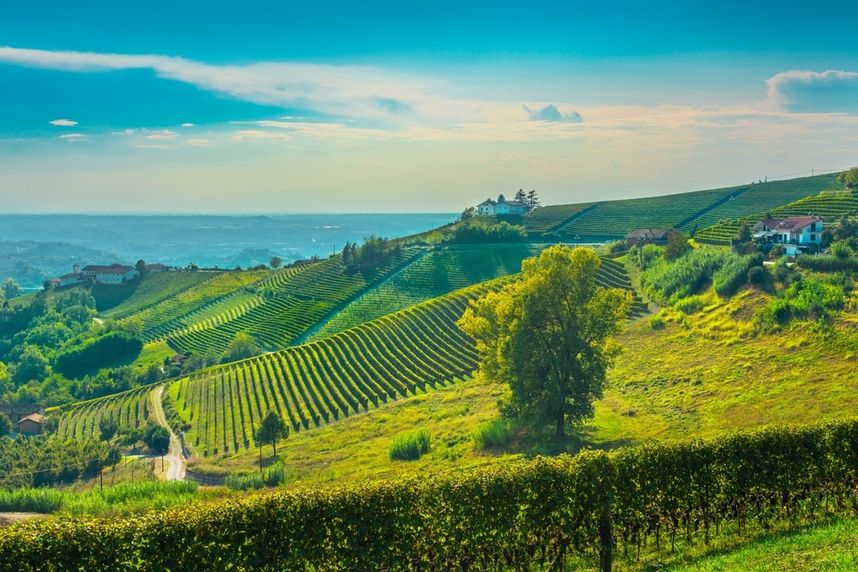
The fact that the production area of Asti Spumante DOCG was included in 2014 amongst UNESCO World Heritage sites speaks volumes about how extraordinary this area is from a historical and landscape perspective.
It is here - between the pronounced hills of Langhe and the gentler ones of Roero and Monferrato, known for Barolo, Barbera and Arneis - that the indigenous Moscato Bianco grapes (also used for the production of Moscato d'Asti) are cultivated with passion and care, giving life to this famous Piedmontese sparkling wine.
The homeland of Asti Spumante - in the provinces of Cuneo, Asti and Alessandria - is not only composed of natural landscapes that enchant the visitor's gaze, but also offers the perfect conditions to express the organoleptic notes of the grape variety at their best: the continental climate, with good thermal variations, alternates harsh winters and hot summers, whilst the soils show a prevalence of sandstone and limestone in the Langhe, and sand, clay and marl in the rest of the area.
Classic or Charmat? The production method of this Piedmontese sparkling wine
Despite the first inspiration for the birth of this wine being Champagne - obtained through second fermentation in the bottle - today the main production method of Asti Spumante DOCG is the Charmat Method (or Martinotti), ideal for enhancing the refreshing notes of the product. According to this procedure, the foam formation takes place in steel autoclaves, with the addition of a liquid composed of yeasts and sugars. Under controlled pressure conditions, so as not to compromise the effervescence obtained, everything is filtered and transferred to other steel containers, and finally bottled and left to mature for a variable period.
However, according to regulations, there are also Classic Method versions, which involves second fermentation in the bottle, together with a syrup based on sugar and selected yeasts. After a resting period, the bottles are regularly turned to favour the deposit of yeast residues, which are finally removed through disgorgement, and then the bottles are topped up with a mixture of sugar and wine (the liqueur d'expédition), which also determines the dosage of the sparkling wine.
A sparkling wine of French inspiration: history of Asti Spumante
It might seem strange to place the origins of Asti Spumante in France, the Italian sparkling wine par excellence, but the world of oenology has always been nourished by influences and points of contact, to give life to iconic labels like this one.
It was 1865 when Carlo Gancia exploited his chemical expertise and the sparkling wine-making knowledge learned in the Champagne region, applying the famous Champagne Method to Moscato Bianco, an aromatic grape variety indigenous to Piedmont.
From this initiative came the first official Italian sparkling wine, a Classic Method sparkling wine with sweet notes and a fairly moderate alcohol content, which can be considered in all respects the ancestor of today's Asti Spumante.
The traditional method was however too slow, complex and expensive for the needs of the time, so Federico Martinotti - at the time director of the Enological Station of Asti - developed in 1898 a more agile and economical procedure, which took the name Martinotti Method. Thanks to this new procedure, the long traditional timelines were streamlined, thus determining the fame and diffusion of this sparkling wine.
After the birth of the Consortium for the Protection of Asti in 1932, this sparkling wine obtained DOC status in 1967 and - as recognition for its quality - DOCG status in 1993. Today this sparkling wine can be sweet or dry depending on the specific dosage, but in each of its variations it conquers wine lovers all over the world. A wine of French inspiration, but 100% Italian!
Do you have a celebration or sweet aperitif coming up? Don't miss the alluring aromas of Asti Spumante, available in the Svinando catalogue!