
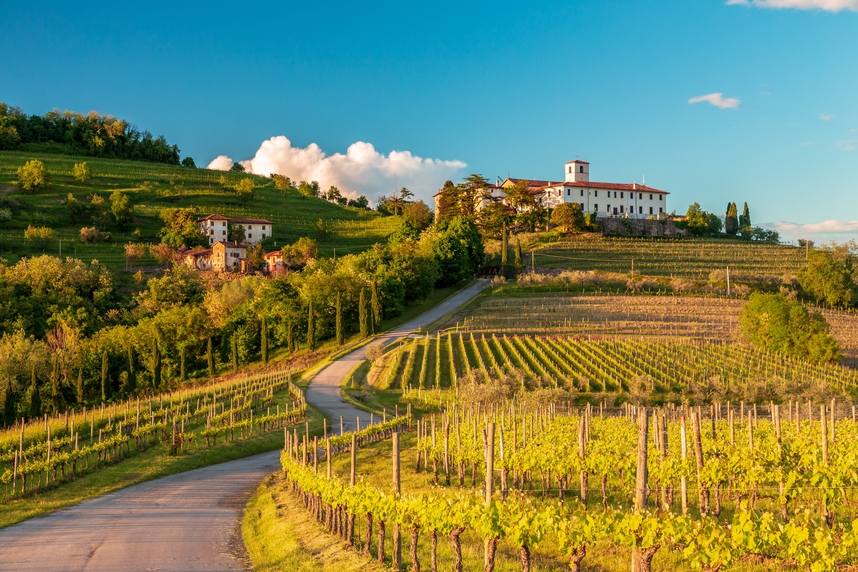
When discussing Italian wine, Friuli-Venezia Giulia is not always the first region that comes to mind. However, when it comes to quality, this area of north-eastern Italy has nothing to envy from the rest of the Peninsula. With its prestigious wine zones, thermal variations and varied soils, the labels it offers to the sector are a true source of pride for local oenology.
Here is a guide to the wines of Friuli, covering history, terroir and recommended food pairings!
Between sea and mountains: the terroir of Friulian wines and the main production areas
Friuli develops across a varied territory rich in influences. The proximity of Austria and Slovenia has given rise over the centuries to fascinating cultural blends, whilst the presence to the north of the Julian Alps and to the south of the Adriatic contributes to tempering the cool and typically Alpine climate of the region, which is responsible – also thanks to the considerable thermal variations – for the slightly acidic nuances and balanced aromas of the wines.
At a geological level, the same variety is evident, with a predominant presence of pebbles, sandstone and marl.
In these particularly favourable conditions, the most important wine zones of the region emerge:
- Collio: in the north-east of the region, near Gorizia and the border with Slovenia, this is a hilly territory famous for its white wines, obtained from Pinot Grigio, Pinot Bianco, Chardonnay, Friulano, Collio Bianco and Sauvignon Blanc. Temperatures are moderated by the proximity of sea and mountains, whilst the soils are composed of a stratified blend of marl and sandstone rich in minerals called ponca, which imparts complexity to the wines. In addition to white varieties, Merlot, Cabernet Sauvignon and Cabernet Franc are also cultivated.
- Colli Orientali: on the border with Slovenia, the area is characterised by hilly terrain, a temperate climate and the same ponca that defines Collio. Here, mainly white wines are produced, from Friulano, Sauvignon Blanc, Pinot Bianco, Ribolla Gialla, Picolit and Verduzzo, whilst the red wines of Friuli are produced here with Pinot Nero, Refosco, Cabernet Sauvignon and Schioppettino.
- Grave: between Udine and Pordenone, it extends over a vast territory bathed by the River Tagliamento. The vines not only enjoy an excellent temperate climate, but also mixed soils of gravel and stone, composed of a good percentage of limestone and capable of retaining soil heat and water from rainfall. Here, wines of various types are produced, from Chardonnay, Sauvignon Blanc, Riesling, Friulano, Refosco, Cabernet Sauvignon and Merlot grapes.
- Carso: characterised by difficult-to-cultivate terrain – ridges, sinkholes and rocky outcrops – this area balances Mediterranean and pre-Alpine continental climatic features, with fairly mild temperatures, powerful winds (the Bora) and scarce rainfall. This last element, combined with very permeable soils, often causes water shortages, compensated for by clayey and silty soils, which retain water. Despite this, Carso is an ancient and highly important wine area, where Vitovska, Malvasia, Glera, Ribolla Gialla, Pinot Grigio, Terrano and Refosco are mainly cultivated.
- Isonzo: in the easternmost area of the region, this zone is characterised by various soil types, from gravelly and clayey soils to calcareous and gravelly ones. The climate is maritime, regulated by the presence of mountains and sufficiently ventilated – an ideal balance for grape ripening, including Pinot Grigio, Sauvignon Blanc, Chardonnay, Malvasia, Friulano and Merlot.
The pride of the region: the best white wines of Friuli
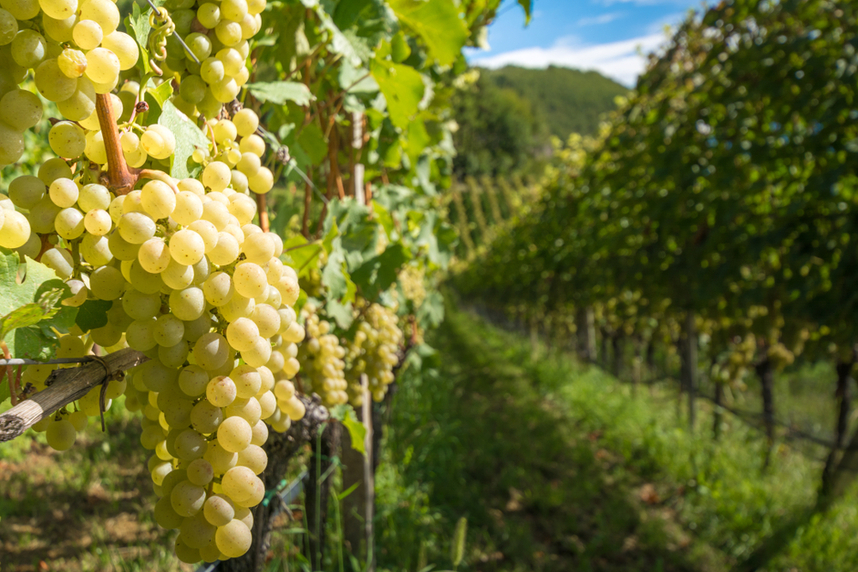
Although Friulian oenology is as varied and multifaceted as its own territory, it is above all on white production that the efforts of winemakers are concentrated. It is the terroir that drives this tradition, contributing significantly to defining the characteristics of the most iconic wines of Friuli. The soils with a good mineral component and the thermal variations, in fact, amplify the complexity of these products, presented here with some pairing suggestions!
Friulano Colli Orientali DOC 2024
The review of the best white wines begins with the most iconic variety of the region, Friulano, a grape variety once called Tocai. Its unknown origin only amplifies the aura of mystery surrounding this grape, perhaps related to a French variety.
Produced mainly in the Colli Orientali area, this product is well represented by Friulano Colli Orientali DOC 2024. The complexity and intensity of the aromas seem to be anticipated by the deep yellow colour, streaked with green and gold. The nose is captivated by citrus notes, enriched by particular notes of tomato leaf and almonds.
As seconds pass, secondary nuances of apricot, peach, gooseberry, cedar zest, bergamot and kiwi also emerge, with floral hints of jasmine, rose and lemon blossom. Well structured, soft and fresh, the palate also reveals a pleasant herbaceous identity, which recalls the aromas of thyme and sage and closes with a slightly bitter aftertaste.
Among the best pairings with Friulian wines like this, tastings of flavourful cured meats and fresh cheeses stand out, to open the rest of the menu in great style. However, it also feels at home with steaks, roasts, salads and escalopes of white meat or with fish dishes of various types.
Malvasia Collio DOC 2024
Another representative grape variety of Friuli is Malvasia Istriana, a variety originating from the Peloponnese area. It seems that it takes its name from the stronghold of Monemvasia, from which ships laden with wine would depart, ready to be traded by the Venetians. Having spread to many areas of Europe, it found in Friuli a maternal and generous land, declining into labels of great prestige, such as this Malvasia Collio DOC 2024.
Ideal to uncork on those evenings when you fancy ordering some sushi for delivery or preparing some refined raw fish at home, this wine expresses vivacity and elegance in every feature, from the greenish hues to the bouquet of citrus and apple. On the palate, it presents a medium structure, with a dry taste that accompanies each mouthful with a pleasant persistence.
Ribolla Gialla "Locatelli" DOC Friuli Colli Orientali 2023
The name alone is enough to suggest a wine that bubbles incessantly in the vats, and indeed this is precisely the etymology of Ribolla Gialla, originally subject to frenzied fermentations due to the malic acid contained in its grapes.
Almost disappeared over the centuries, this variety was rediscovered in the 20th century, becoming one of the most cultivated varieties in Friuli, especially in Collio and Colli Orientali.
Versatile at the table, Ribolla Gialla "Locatelli" DOC Friuli Colli Orientali 2023 displays a bright straw yellow colour and mineral notes that are clearly perceptible throughout the tasting. It accompanies the aromas of citrus and white flowers, but also the notes of peach and apple that emerge on the palate. The structure is balanced, whilst the aftertaste is citrusy, herbaceous and slightly almond-like.
Thanks to these captivating and refreshing features, this Ribolla represents an excellent companion for the last outdoor lunches of the season, amongst tastings of salads, savoury pies, vegetable skewers and flavourful preparations based on cured meats and cheeses. It also delivers a magnificent experience with fish dishes – from refined raw preparations to grills, from roasts to pan-fried fillets – or with those warm soups that present a slight acidic nuance.
Red wines of Friuli: small masterpieces to drink and pair
A land of great whites, Friuli also knows how to enchant red wine lovers with a range of proposals that are fruity, elegant and with an intense bouquet. In this case too, local varieties sit alongside international ones, offering variety, taste and character!
"Pucino" Refosco dal Peduncolo Rosso DOC 2023
The most renowned and important native grape variety of Friuli, Refosco dal Peduncolo Rosso has been widespread in the area since ancient times and appears to be the progenitor of other red grape varieties, such as Marzemino. The name is not due to the colour of its grapes but, unexpectedly, to that of its leaves, particularly the section that attaches to the plant (the peduncle, in fact), which is a bright purple colour.
A worthy representative of this native variety is "Pucino" Refosco dal Peduncolo Rosso DOC 2023, the result of careful vinification that aims to amplify the freshness of the grape. The result is a ruby colour with violet hues and an aromatic profile that evokes images of wild blackberries and raspberries, with a hint of liquorice that makes the tasting even more complex. The palate is a caress with herbaceous and refreshing tones that immediately invites a second taste.
Its place at the table is found alongside common chicken and turkey preparations, but it also surprises with seafood dishes with a structured flavour, such as starters with smoked herrings, fish pies, roasted turbot fillets, fish soups with haddock and jellied eels.
Merlot DOC Friuli Isonzo 2022
Whilst Friulian oenology continues to amaze wine lovers with excellent native varieties, production with international grape varieties produces equally marvellous results, such as this Merlot DOC Friuli Isonzo 2022. The grape variety – originating from the French département of Gironde – has found in the hills of Friuli the ideal environmental conditions to best express its fruity identity.
In this version produced in the Isonzo area, Merlot is the starting point for creating a wine with an elegant ruby red colour and engaging aromas of red and dark fruits, such as raspberries, blackberries and blueberries, typical of the grape variety. This character makes it perfectly suited to standing up to the intense flavour of semi-mature cheeses and red meats subjected to long cooking, such as roasts, braised dishes, stews and pies.
A long history, between tradition and innovation
The origins of wine in Friuli date back to antiquity, when local Celtic populations began to develop the vineyards, giving rise to the first wines. However, it was the Romans who introduced the first innovations, exploiting the full potential of the hilly areas of the region to produce excellent wines for drinking and trading.
With the fall of the Roman Empire, it was the initiatives of Benedictine monks that ensured the survival of local grape varieties. Thanks to the monasteries, advanced techniques spread that favoured trade throughout the Renaissance as well.
In the 20th century, the influence of the Austro-Hungarian Empire encouraged the spread of new grape varieties and new techniques, but local oenology suffered a slowdown during the crisis caused by the Second World War. In the post-war period, Friulian viticulture slowly recovered, but with surprising results: producers decided to focus on local varieties, defining the style of Friulian wines and giving voice to the authentic character of the region!
Now that you have mastered knowledge of Friulian wines and their pairings, it is time to conclude this journey with the right bottle. You'll find it in the Svinando catalogue!